
Tuesday, 1 September 2026
Industrial 3D vision adds depth to measure, inspect or guide a robot when 2D vision is no longer enough, particularly for three-dimensional parts, surface relief, bin picking and robot guidance. This guide explains how it works, its four main families of technologies, and the applications where it makes a concrete difference in production […]
Industrial 3D vision adds depth to measure, inspect or guide a robot when 2D vision is no longer enough, particularly for three-dimensional parts, surface relief, bin picking and robot guidance. This guide explains how it works, its four main families of technologies, and the applications where it makes a concrete difference in production: 3D vision robot guidance, bin picking, dimensional quality control.
What is industrial 3D vision?
Industrial 3D vision covers the technologies that measure the depth of a scene, in addition to its surface, so that an automated system can inspect, measure or guide a robot precisely.
A conventional 2D camera sees a flat image. A 3D camera adds a third piece of data: the distance of each point from the lens. The result is called a point cloud: a three-dimensional map of the observed scene.
This map makes it possible to reconstruct the exact position of an object, its orientation and its volume. The sensors used vary: stereoscopic, time of flight, structured light or laser triangulation. Increasingly, they are coupled with deep learning models to recognize complex shapes, even on parts never seen before.
In production, three uses dominate: dimensional quality control, precision measurement and robot guidance, particularly for picking loose parts. 2D vision cannot do the latter on its own.
Not to be confused with human 3D vision, which describes the perception of depth by
the brain and the retina. Here, the subject is purely industrial: cameras and
algorithms applied to a production line, not biology.
CEA-List, a French public research institute, has been working for several years on real-time 3D localization applied to bin picking and depalletizing. Its work confirms a simple point: the more symmetrical or shiny a part is, the harder it becomes to locate, whatever technology is chosen.
This difficulty explains the rise of deep learning in this sector in recent years. A well-trained deep learning model can generalize better than a fixed geometric rule when shapes, orientations or imaging conditions vary widely.
How does a 3D vision system work?
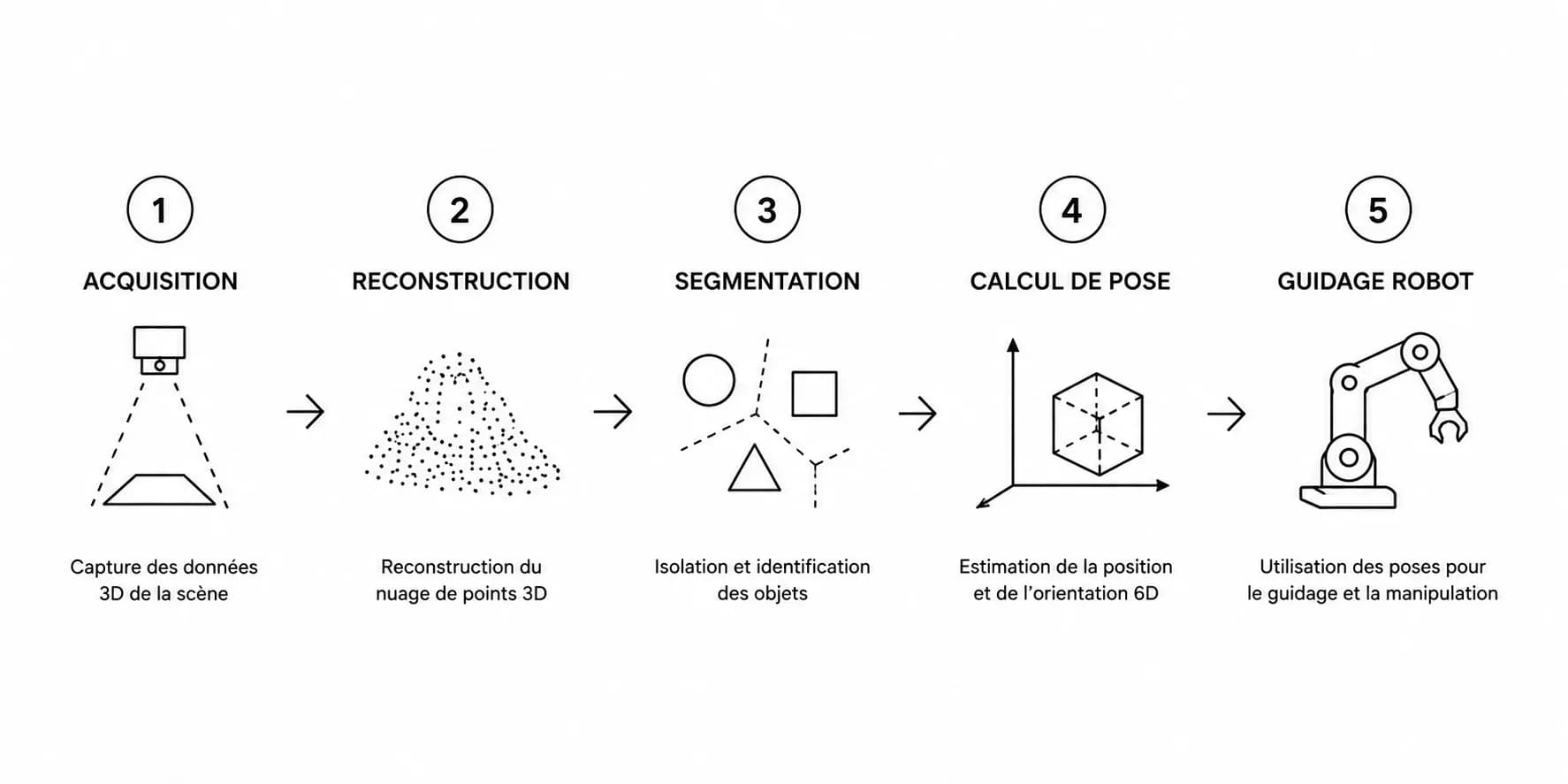
A 3D vision system follows five steps: image acquisition, point cloud reconstruction, object segmentation, pose calculation, then transmission of the coordinates to the robot. Each step depends on the previous one: an error upstream carries through all the way to the robot arm.
- Acquisition. One or more 3D cameras capture the scene and produce a point cloud. On a bin-picking line, several viewing angles compensate for parts that overlap in the bin.
- Reconstruction. The software reconstructs the three-dimensional geometry of the observed scene. This step turns a raw point cloud into a surface usable by the following steps.
- Segmentation. The objects of interest are isolated from the rest of the scene: bin, conveyor or background. Here, a deep learning model distinguishes a part from a shadow or a reflection.
- Pose calculation. An algorithm calculates the exact position and orientation of each object. This pose comprises six values: three for position, three for rotation.
- Transmission to the robot. The 3D coordinates are sent to the robot controller to guide the gripping. The robot adjusts its path within a few milliseconds, without restarting the cycle.
Before running these five steps in production, each camera must be calibrated: the exact position of the sensor relative to the scene and the robot is measured once, then recorded. A poorly performed calibration shifts all the coordinates transmitted afterwards, even if the rest of the chain works perfectly.
Psycle's Python SDK covers these five steps in a single framework. It is designed for teams that want to stay in control of their deep learning models rather than depend on a proprietary black box.
What are the main 3D vision technologies?
There are four main families of 3D vision technologies: stereo vision, time of flight, structured light and laser triangulation. Each involves a different trade-off between accuracy, speed and working distance.
Technology | Principle | Accuracy / Speed | Typical use case |
|---|---|---|---|
Stereo vision | Two cameras, disparity calculation like human vision | Good accuracy, moderate cost | Quality control, general measurement |
Time of flight (ToF) | Measures the return time of a light pulse | Fast, medium accuracy, long range | Long-distance robot guidance |
Structured light | Projection of a light pattern analyzed by a camera | High accuracy, limited range | Precision metrology, small parts |
Laser triangulation | Laser scanning and geometric calculation of the deformation | Very high accuracy, high speed possible | Bin picking, fine dimensional inspection |
The choice almost always depends on the part to be processed. A shiny metal part reflects structured light and distorts the measurement; a time-of-flight sensor tolerates this type of surface better, at the cost of some accuracy: a trade-off frequently observed in certain ranges of industrial sensors. Psycle systematically evaluates the customer's actual sample before choosing the technology, rather than applying a standard solution.
This evaluation step often takes the form of an on-site test, with the customer's actual parts, before any commitment to a technology. Psycle presented this approach at SEPEM Industries Douai 2026, where several customer samples were tested live on different sensors.
3D vision and robot guidance: what industrial applications?
3D vision guides a robot arm in three ways: it locates the part, calculates its gripping path, then corrects its position in real time. These three functions apply in the food, automotive and logistics industries.
- Part localization: finding a part whose position has not been calibrated in advance, such as a bottle that has slid on a conveyor or a part coming out of a mold with no fixed orientation.
- Path calculation: defining the safest route to grip the part without hitting its neighbors, a calculation that must remain compatible with the line speed.
- Real-time correction : adjusting the robot's movement if the part moves between detection and gripping, for example due to conveyor vibration.
These three functions avoid the need for dedicated positioning tooling for each product reference: a direct gain as soon as a line handles several formats.
At Aretec, this approach simplified the integration of AI-assisted machine vision on an existing line, without redesigning the entire robotic cell. At Himber Technologies, Psycle vision was integrated into an existing station, without prolonged production downtime.
See our 3D vision robot guidance solutions
Bin picking: a major use case for industrial 3D vision
3D bin picking consists of identifying and picking loose parts from a bin, without them being arranged or oriented in advance. It is the most common application of 3D vision in production.
The difficulty does not come from the part itself, but from the disorder. Parts touch, overlap and sometimes deform. A 2D vision system cannot tell two stacked parts apart; a 3D system can, thanks to the pose calculation described above.
Some materials make the task even harder: transparent materials let the sensor's light through, flexible ones change shape between two picks, and very shiny ones create reflections that look like edges. Each case requires adjusting either the technology or the segmentation algorithm.
MCA Process improved the bin picking of unpackaged products with Psycle: parts without packaging, difficult to grip without a clear visual reference. In another customer case, Psycle brought order to a bin of nuggets to enable their automated picking. The same principle applies to mechanical parts, bottles and flexible packaging.
3D vision vs. 2D vision: what are the differences?
2D vision measures a surface in width and height. 3D vision adds depth. This third dimension changes everything as soon as a part is not lying flat in a known location.
Criterion | 2D vision | 3D vision |
|---|---|---|
Dimensions measured | Width, height (x, y) | Width, height, depth (x, y, z) |
Typical use case | Code reading, flat surface inspection | Robot guidance, volume measurement, bin picking |
Main limitation | Does not detect relief or the real position in space | Higher cost and computation time |
2D vision remains relevant for reading a barcode or inspecting a label on a flat surface: it costs less and processes images faster. It reaches its limits as soon as you need to locate an object in space, measure surface relief or guide a robot toward a loose part.
In practice, many lines combine the two: a 2D camera for quality control at the end of the line, and a 3D camera upstream to guide the robot feeding that same line. Each technology stays on the task where it is most effective, rather than forcing a single system to do everything.
Frequently asked questions
Robot guidanceWhat is industrial 3D vision?
Industrial 3D vision covers the technologies that capture the depth of a scene, in addition to its surface, so that an automated system can measure, inspect or guide a robot precisely. It relies on specialized cameras and three-dimensional reconstruction algorithms applied in production environments.
Robot guidanceWhat is the difference between 2D vision and 3D vision?
2D vision analyzes a flat image, in width and height, which is enough to read a code or inspect a surface. 3D vision adds depth, which is essential for locating a part in space, measuring surface relief or guiding a robot in a bin of loose parts.
Robot guidanceWhat 3D vision technologies are there?
The four main families are stereo vision, structured light, time of flight (ToF) and laser triangulation. Each offers a different trade-off between accuracy, speed and working distance, to be chosen according to the target industrial application.
Robot guidanceHow does 3D vision improve robot guidance?
It allows the robot to locate a part whose position is not known in advance, for example loose in a bin, and then to calculate a suitable gripping path in real time, without dedicated positioning tooling.