Robot arm-mounted inspection
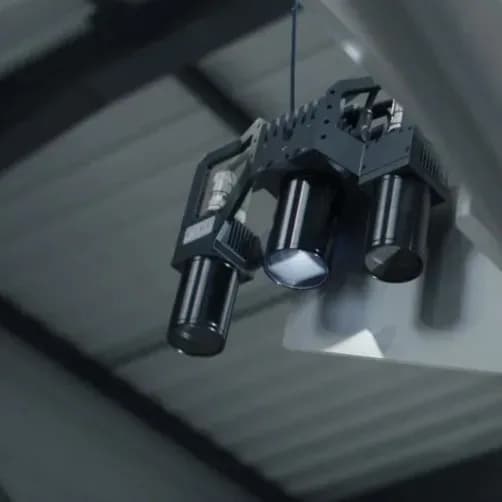
Mounting the camera directly on the robot arm makes it possible to combine guidance and quality control in a single cycle, with no dedicated inspection station, reducing line footprint and cycle time.

Quick links
Automate your complex picking, bin-picking and assembly tasks. Our vision solutions free your robots from the rigidity of mechanical tooling.
Mounting the camera directly on the robot arm makes it possible to combine guidance and quality control in a single cycle, with no dedicated inspection station, reducing line footprint and cycle time.
Vision-based robot guidance positions each component with sub-millimeter accuracy for insertion, screwing or clipping operations, even when the part arrives in an uncontrolled pose.
Poultry, vegetables, pastries: picking non-rigid or irregular products from a bin or a moving belt requires vision that can handle deformation, glossiness and variations in shape at industrial speeds.
Mixed layers, disorganized packages, variable heights: 3D vision algorithms detect each unit and calculate the optimal unstacking sequence for autonomous operation without human intervention.
Machine vision identifies and classifies heterogeneous flows in real time by type, shape or color, to guide a sorting robot with a precision that conventional detection systems cannot achieve.
3D localization of loose parts allows the robot to calculate the optimal pick without a dedicated gripper or organized feeding. At Psycle, vision models adapt to the diversity of shapes and materials.
.01
We carry out hand-eye calibration, fixed or robot-mounted, to guarantee consistent robot guidance accuracy throughout the cell's entire workspace.
Align the camera and robot coordinate frames in a few minutes with our guided calibration tools, with no manual matrix calculations or 3D vision expertise.
.02
We select the 3D sensor suited to your parts and your environment: stereo vision, time of flight or structured light, depending on the required accuracy.
Native drivers control the main 3D sensors on the market and deliver point clouds that are already filtered and denoised, ready for localization.
.03
Our algorithms isolate the target part and calculate its pose (X, Y, Z, Rx, Ry, Rz), taking into account obstacles and your robot's joint limits.
A geometric localization API and anti-collision functions let you define safe, optimized pick points for each product reference.
.04
We integrate communication between the vision system and your robot controller, from coordinate frame transformation to trajectory transmission.
Communication libraries transmit trajectories and coordinates with minimal latency, via sockets, EtherNet/IP or PROFINET.
This speed of adaptation is decisive in contract packaging, where the variety of products and the frequency of changeovers make conventional reprogramming too costly. By adapting to a new product in around thirty minutes, the Psycle solution makes it possible to handle varied production runs without sacrificing productivity. Flexibility no longer comes at the expense of throughput.
The benefit of masked-time processing is direct: it reduces, or even eliminates, the time the robot would spend waiting for a decision from the vision system. On a timed operation, every second saved per cycle is multiplied across the entire production. It is one of the levers through which Psycle's solutions use AI to reduce robot cycle times, without changing the robot itself.
The difference lies in where the camera is placed. With on-board vision, the module is mounted on the robot arm: it only sees what surrounds the gripper, and you have to wait for the movement to finish before observing anything else — so you depend on the cycle time. With remote vision, the camera is separate from the robot: it observes wherever you want, whenever you want, independently of the movement in progress.
3D bin picking covers two main configurations: picking parts from a bin or a pallet — typical of depalletizing — and picking loose products directly from a conveyor, common in contract packaging. Psycle designs these applications to absorb variations in both the product and its presentation without heavy reprogramming: a new product reference is handled within a few dozen minutes, which makes it a realistic solution for lines with frequent format changes.
In industry, 3D vision is mainly used to guide robots on tasks that 2D cannot handle: picking parts from a bin, depalletizing, or locating a product whose position varies with each cycle. Psycle's applications use this real-time localization so that machines adapt to unpositioned products and variable environments, without jigs or mechanical fixturing.
Beyond localization, vision guidance is mainly about gaining performance and flexibility: a robot that can see is able to handle loose products, absorb variations in position and reduce its cycle times. Psycle's guidance solutions rely on AI so that machines adapt to variable environments with a fluidity close to human movement, where a conventional robot would require perfect positioning.
Every failed pick tells you something: a badly presented part, a reference never encountered before, a drift setting in. With our monitoring platform, your robotic cells no longer just run cycle after cycle: they log images of missed picks, analyze trends and alert you before the success rate drops.
psycle solutions
Localization, gripping, placement: adapt your robots' accuracy to the real constraints of your line.