
AI industrial quality control consists of translating a product's conformity criteria into decision rules, then having a camera and an algorithm apply them to every part, at line speed and without any lapse in attention.
At Psycle, these criteria are never set on your behalf: it is your quality inspectors who establish what a compliant product is, and this definition becomes the foundation of the machine vision system.
Poor quality has a measurable cost. According to the AFNOR 2023 survey of 816 French industrial companies, 66% estimate their cost of poor quality at less than 5% of their revenue, but 15% put it above 10%. A well-calibrated vision system acts directly on this cost item, detecting the defect at the source rather than at the end of the chain.
What can a machine vision system inspect?
Foreign body detection
Psycle machine vision systems detect metal, plastic or bone fragments in real time on your food production lines, before they reach the consumer or damage your equipment.
Crack and micro-defect detection
Non-destructive testing by machine vision identifies cracks and micro-defects on welds and stressed parts in the nuclear and defense sectors, where zero tolerance is a must.
Surface inspection
Scratches, cracks, inclusions, porosity: automated vision inspection detects surface defects invisible to the naked eye on metal or plastic parts, however complex their geometry.
Dimensional inspection
Dimensions, tolerances, gauges: machine vision measurement solutions check the geometric conformity of your mechanical parts and packaging without contact, at production speed.
Seal integrity
Defective heat seals, misapplied lids, non-compliant caps: machine vision inspects 100% of food and pharmaceutical packaging to guarantee leak-tightness and regulatory compliance.
A rigorous methodology for industrial performance
.01
Optical qualification
Project mode
We analyze your samples in the lab to define the ideal vision setup: lighting, optics and sensors suited to the defects to be detected on your products.
SDK mode
Develop your own tools to help choose and adjust optics, so you can qualify your installations your own way and get a usable image from the very first trials.
.02
Development & AI
Project mode
Our developers assemble the building blocks specific to your needs while our engineers train the AI models on the real variability of your products.
SDK mode
You use our annotation tools and preconfigured training pipelines to train and deploy your own detection models in record time.
.03
Commissioning
Project mode
We install the vision system on your line, adjust the parameters to field constraints and validate performance during commissioning.
SDK mode
The modular architecture integrates with your industrial PCs and communicates natively with your PLCs via standard protocols: PROFINET, EtherNet/IP and OPC UA.
.04
Monitoring
Project mode
We monitor detection performance and maintain your turnkey solution, for quality that stays under control over time.
SDK mode
You manage your deployments with the built-in diagnostic tools and connect your machines to PAQ, our real-time monitoring platform for your fleet of vision systems.
Frequently asked questions about our vision solutions.
Go to the FAQQuality controlCan a vision-based quality control system evolve with new defects or products?
A product change does not mean starting from scratch. Psycle's software is designed to adapt quickly: when a new product reference is launched, new inspection rules are defined so it can go into production as soon as possible. You absorb changes to your product range without replacing your vision system.
Quality controlHow can you limit false rejects (false positives) in vision-based quality control?
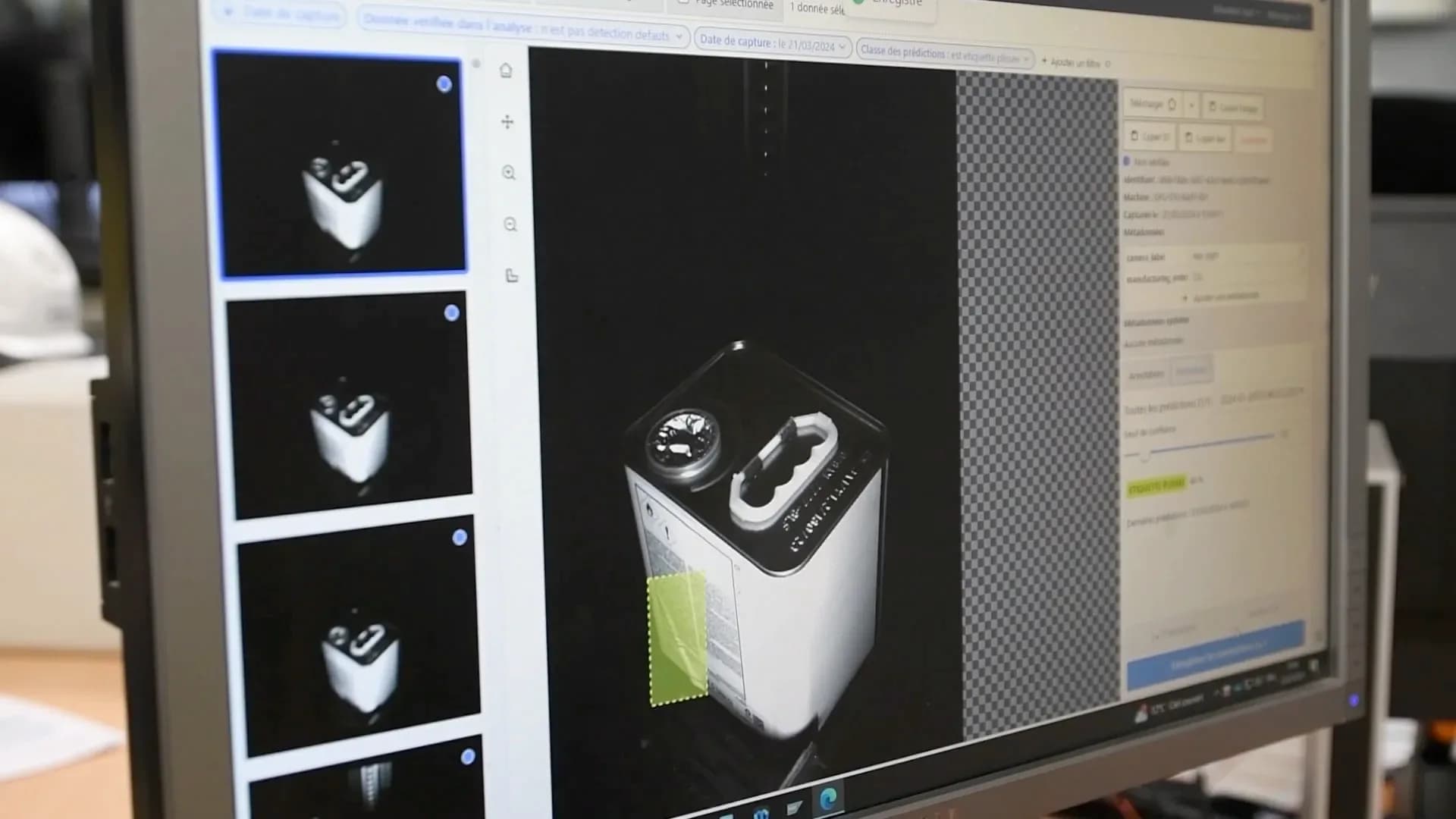
False rejects decrease over time thanks to annotation. When a compliant product is wrongly rejected, your teams can flag and annotate it: the system incorporates this case and refines its decision for all vision stations. At Psycle, every correction benefits all your lines, which gradually lowers the false positive rate.
Quality controlIs 100% quality inspection of production really possible with vision?
A 100% inspection can be trusted provided the system is calibrated on your real cases and its decisions remain verifiable. At Psycle, reliability comes from inspection rules defined on the basis of your expertise and from transparent indicators, never from a black box. You stay in control of what is deemed compliant, which makes automated inspection trustworthy in production.
Quality controlWhat types of defects can a vision system detect?
A machine vision system detects five main families of defects, whatever the industry: cosmetic defects (scratches, stains, deformation, dents, corrosion), conformity defects (presence/absence of a component, assembly or orientation error, incorrect label or marking), dimensional defects (out-of-tolerance dimensions, misalignment, positioning), sealing, crimping or welding defects (leak-tightness, hermeticity), and the presence of foreign bodies. These inspections apply equally to food packaging, a metal part, an electronic assembly or a component in a critical environment — all areas covered by Psycle.
Quality controlWhat is machine vision quality control?
A vision-based quality control system combines controlled lighting, one or more cameras and decision software, installed directly on the line. Each time a product passes, the image is compared with the conformity criteria agreed with your teams, and the verdict comes in a few milliseconds, fast enough to trigger an ejection without slowing down the line.
The difficulty is almost never seeing the defect: it is distinguishing it from the product's normal variations. That is what is at stake during optical qualification, before a single line of code is written, and what separates a system that is reliable in production from a successful demonstration in the lab.
Don't just eject. Analyze.
Every reject is valuable information. With our monitoring platform, your quality control systems no longer just isolate non-conformities: they log images, analyze trends and alert you when your machines drift.
psycle solutions
Reliable quality control, at every station
Adapt the level of inspection to your production requirements, without slowing down the line.