
Thursday, 18 June 2026
On a foundry line, two operators look at the same metal part. Both identify a defect. Yet their conclusions differ. For one, the part can continue on its way. For the other, it must be rejected. This situation is far from exceptional in industry. Behind every quality inspection lies an element of human expertise, often intuitive, […]
On a foundry line, two operators look at the same metal part. Both identify a defect. Yet their conclusions differ. For one, the part can continue on its way. For the other, it must be rejected. This situation is far from exceptional in industry.
Behind every quality inspection lies an element of human expertise, often intuitive, difficult to formalize and even more complex to pass on to a machine. Because contrary to popular belief, artificial intelligence does not become effective simply because it is given thousands of images. You still need to know what information to include, what to leave out and, above all, understand what the experts are really trying to observe.
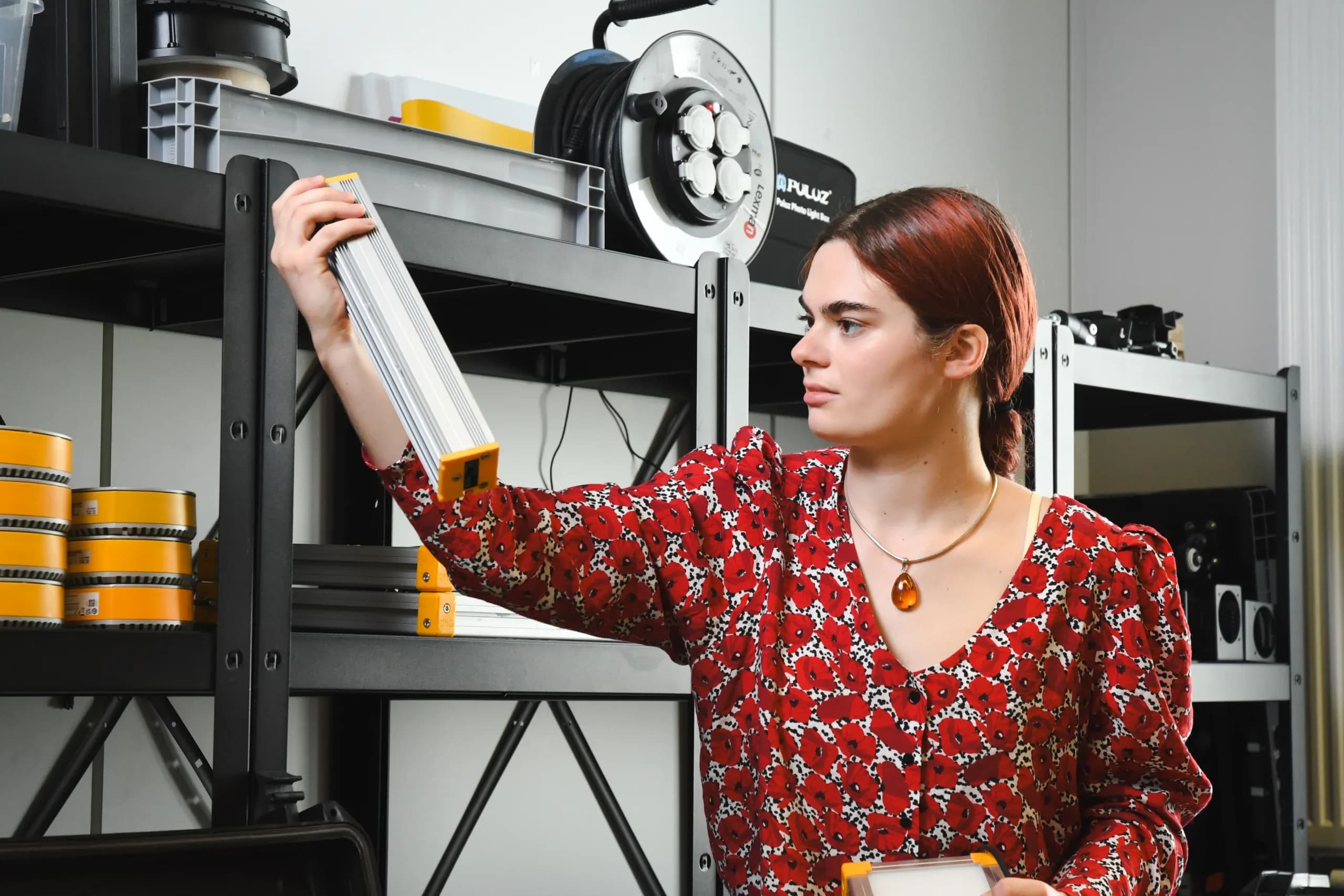
It is precisely at this frontier between trade, technology and human understanding that Gabrielle Van de Vijver, vision application engineer at Psycle, comes in. Having joined almost two years ago after a final-year internship, she now contributes to the development of machine vision systems capable of assisting operators without ever replacing their expertise.
The operator: the algorithm's best teacher?
Recently, Gabrielle worked on a project involving foundry defect detection. To understand the customer's expectations, she spent almost a full week alongside the operators: observing the lines, informal discussions, analyzing parts, understanding defects. The teams even went as far as handing her old technical books dating back to the '80s.
“While talking with an operator, I realize that a visually obvious defect is corrected by light sanding. Conversely, a detail imperceptible to the eye affects the very structure of the part. I try to identify this kind of issue before passing it on to the algorithm.”
The difficulty quickly becomes apparent. Not all operators use exactly the same criteria. Habits differ. So do interpretations. It then becomes necessary to gradually build a common language: frameworks understandable both by business experts and by artificial intelligence. For Psycle, the point is not to try to make AI omniscient, but rather to push it to refine itself so that it becomes useful.
“The goal is not to gather all the expertise in the world into a single artificial intelligence. What matters is that it is reliable on the problem it is asked to solve.”
Understanding the trade before automating
Psycle's projects regularly lead the teams to discover worlds they are unfamiliar with: foundry, food, radiography, biology, aerospace, logistics. For Gabrielle, this diversity is one of the great assets of the job.

Some biological categories, for example, can take several different visual forms. Whereas a mechanical part generally meets relatively stable criteria, living things introduce much greater variability.
“Biological subjects fascinate me. Living things don't follow a production order; they escape strict categories. The algorithm has to learn to deal with ambiguity and unpredictable phenomena.”
A vision project is not just a camera
When machine vision comes up, many people immediately imagine a camera watching products on a conveyor. But the reality is far more complex.
Behind every installation lie dozens of parameters to master. Lighting, object movement, depth of field, mechanical constraints, line speeds, communication with PLCs, and the interfaces used by operators.
This complexity explains why Psycle's projects regularly bring together several complementary areas of expertise:
“You can easily recognize who wrote a set of specifications or a piece of code. Every team member has a strong sensitivity, whether optical, mechanical or software-related. Psycle really encourages this complementarity.”
A way of working that also accompanies the company's recent growth. Since she joined, Gabrielle has seen headcount rise sharply and projects grow in scale. The offices have changed, and so have the teams. The versatility of the early days is gradually giving way to increasingly specialized expertise.
A mix of technology and teaching
One of the ideas that comes up most often during the interview concerns communication. Because contrary to popular belief, the difficulties are not always technical. Sometimes the main obstacles are even human.
“The amount of data can be dizzying. Field experts are often thrown at first.”
Her role is then to make the subject concrete: show an image, illustrate a defect, go back to the trade. Because essential information is almost never given spontaneously. You often have to go and find it, and know how to ask the right questions.

Gabrielle owes this approach partly to her education. After a scientific curriculum combining mathematics, artificial intelligence and data science, she chose a “Humanities and Technology” track at UTC, convinced that an engineer never simply executes.
“We also have a responsibility to understand what our choices imply and what they produce around us.”
A conviction that sheds light on her whole way of working: developing an AI system is not just about aiming for the best performance, but about understanding what you are really trying to measure. And above all, why. Omniscient models hold little interest for her. For her, technology must remain a tool in the service of human expertise. Not the other way around.
Safety shoes: a wise choice
One last story remains: that of how she came to Psycle.
At the time, Gabrielle was finishing her studies and had a pair of safety shoes she no longer needed. She posted an ad on a UTC Facebook group to sell them. Days went by without a response. Then a message arrived:
“I'm a data science engineer too! And yet I use my safety shoes every day. You should keep them just in case.”
The conversation ended there, though, as the size didn't match. A few weeks later, Gabrielle came across a particularly interesting internship offer. Looking at the name of the person who had posted it, she immediately recognized that of the young woman. Today, they work together at Psycle. And the shoes are still around.
“In the end, they were never sold. I use them almost every day now. I promised myself that if a computer science student ever wanted to sell hers, I would reply exactly the same thing.”
And in the end, you realize that Gabrielle is her own artificial intelligence. An intelligence that feeds on customers' knowledge, their trades and their constraints.
And who still wears safety shoes (dust-free).